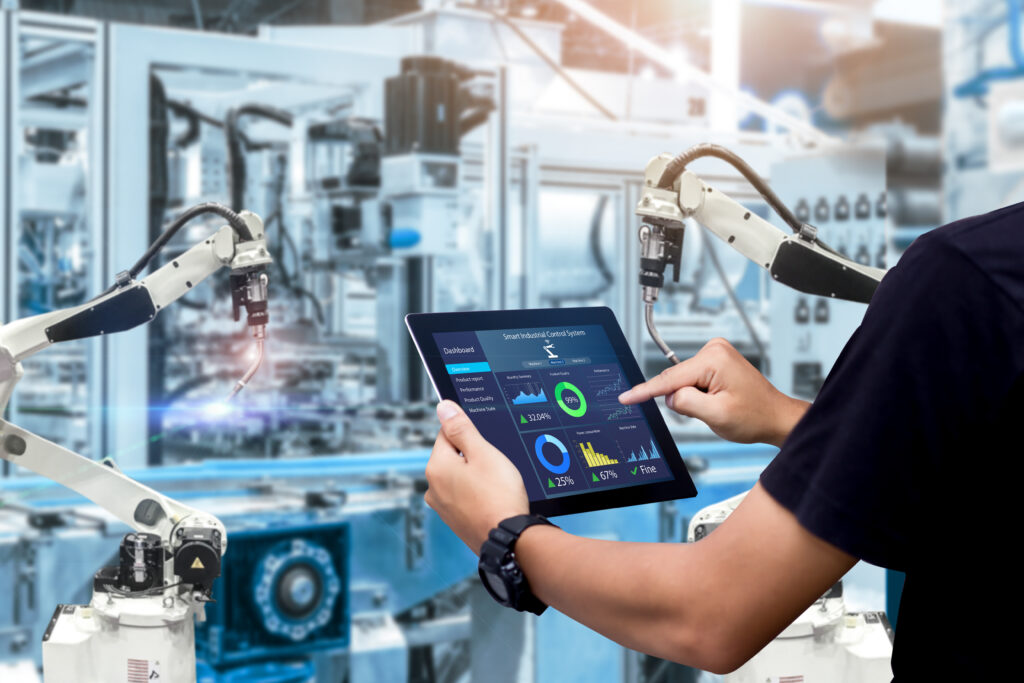
Manufacturing automation is entering a new phase. AI and robotics are being combined with connected production systems, enterprise data and real-time decision-making, extending robotics beyond tightly defined repetitive tasks. The consequence is Industry 5.0 and a more interconnected technology estate that requires people capable of making robotics, operational technology and enterprise platforms work as one coherent environment.
Jump To:
AI and Robotics Are Moving Beyond Traditional Automation
Industrial robots are not new to manufacturing. What’s changing is the level of intelligence, connectivity and adaptability being built around them. Conventional industrial robotics typically excelled in highly structured environments where movements, tolerances and outputs can be tightly prescribed. AI enables machines to interpret more complex inputs, adapt to variation and support increasingly sophisticated decision-making, which is broadening automation opportunities.
AI and robotics are now key components in connected factories where robotics, sensors, manufacturing systems, ERP platforms, analytics and human decision-makers continuously exchange information. Industry figures back this up. According to IEEE research, 35% of leading technologists identify supply chain and warehouse automation as a top AI use case. PwC, meanwhile, expects manufacturers to more than double their use of automation, artificial intelligence and other advanced technologies by 2030.
Even humanoid robotics is moving from concept towards industrial experimentation. SAP is already piloting humanoid robots in warehouse operations to examine how they could improve efficiency, strengthen safety and support new workforce models across industrial supply chains.
The crucial implication of the wider application of AI robotics and the future of jobs, is that as automation becomes more capable, the technical work surrounding it becomes more complex.
The Connection Between Robotics and SAP
The relationship between AI and robotics and enterprise technology is a strategically important one.
A robot completing a task is only one part of a manufacturing process. Connected robotic equipment generates data relating to throughput, cycle times, faults, utilisation, component consumption, quality deviations and machine condition. When that information is integrated with SAP environments, it can inform a much wider set of operational decisions and can have implications across production planning, asset management, quality, inventory and supply chain operations.
The value of smart manufacturing therefore depends less on any individual machine than on the architecture surrounding it. As industrial automation and robotics become more sophisticated, manufacturers need people who understand how a robotic systems perform, how it interacts with processes elsewhere in the enterprise, and how its data should move to create wider business value.
The Roles Emerging Around Connected Automation
A more diverse manufacturing technology workforce is being created. Established roles are changing, while others are emerging at the intersections between SAP, operational technology, automation and data. The result is a growing category of robotics jobs in which domain boundaries matter less than the ability to operate across them.
- SAP manufacturing specialists, particularly professionals with expertise across production planning, plant maintenance, quality, warehouse management and supply chain processes. However they need to understand how automated production environments influence the processes configured within SAP.
- SAP integration specialists connecting robotics, MES platforms, industrial IoT systems and external applications with SAP requires expertise across APIs, integration architecture and SAP BTP as well as a strong understanding of the underlying business process.
- Automation and robotics engineers operating within a broader technology landscape. Their remit extends beyond machinery and controls into connectivity, data availability, cybersecurity and enterprise integration.
- Data engineers and analytics professionals capable of structuring, governing and interpreting industrial data, and for digital manufacturing specialists who can translate between plant operations and enterprise platforms.
- Solution architects who are capable of assessing disparate components as a system rather than as separate technologies.
Why Hybrid Technology Skills Are Difficult to Recruit
Traditional recruitment processes tend to work best when roles fall into established categories. Connected manufacturing increasingly does not. Keyword-led searches can therefore produce candidates who match the technologies listed in a job description without necessarily possessing the breadth required to make those technologies work together.
There is also a timing problem. By the time a hybrid role has become sufficiently common to acquire an established job title, organisations may already be competing for a relatively small population of experienced professionals.
That makes recruitment for AI and robotics as much a capability-mapping exercise as a candidate-search exercise.
How to Identify and Secure the Right Skills
Manufacturers can improve their access to these profiles by changing how they define and approach recruitment.
- Start with Integration Points
Map where robotics and automation exchange data with MES, SAP S/4HANA, SAP Digital Manufacturing, SAP BTP, analytics platforms and other systems. These interfaces reveal the combinations of expertise the programme actually requires. - Define Outcomes Before Job Titles
Specify whether an individual needs to integrate robotic data into production planning, establish predictive-maintenance workflows, architect SAP-to-OT connectivity or improve manufacturing analytics. The required profile often becomes clearer once the business outcome is explicit. - Separate Essential Depth From Adjacent Knowledge
Very few candidates will be experts in SAP, robotics, automation, AI and data simultaneously. Identify the discipline in which genuine depth is non-negotiable, then distinguish the complementary capabilities required to operate effectively across teams. - Assess Operational Fluency
Technical credentials alone are not sufficient. Candidates working across AI and robotics and SAP need to understand the consequences of technology decisions within live manufacturing environments, including availability, safety, production continuity and data integrity. - Build Robust Talent Pipelines
Mapping scarce profiles before programme mobilisation provides a clearer view of availability, compensation and potential resourcing constraints. It also creates options across permanent hiring, specialist contracting and internal capability development.
Building Capability Around the Next Wave of Automation
The expansion of AI and robotics will create further automation opportunities, but manufacturers will need the capability to integrate robotics with enterprise platforms, govern increasingly valuable operational data, protect connected environments and convert machine output into better planning and decision-making. That puts a premium on professionals who can move confidently between previously separate disciplines.
Whitehall has spent more than 18 years recruiting across SAP, IT and data markets, with specialist knowledge of how changes in enterprise technology translate into new hiring requirements. Our consultants help organisations identify professionals with the right combination of SAP knowledge, manufacturing context, automation expertise and data capability.
If you are building or expanding an SAP-connected manufacturing environment, contact Whitehall to discuss your requirements.
About the Author
Whitehall Resources is a global SAP recruitment agency. Thanks to our curated and expansive network of seasoned SAP candidates, we can help find you the specialist professionals you need to support your SAP projects. Find out more about our services.